
By Lydia Turner
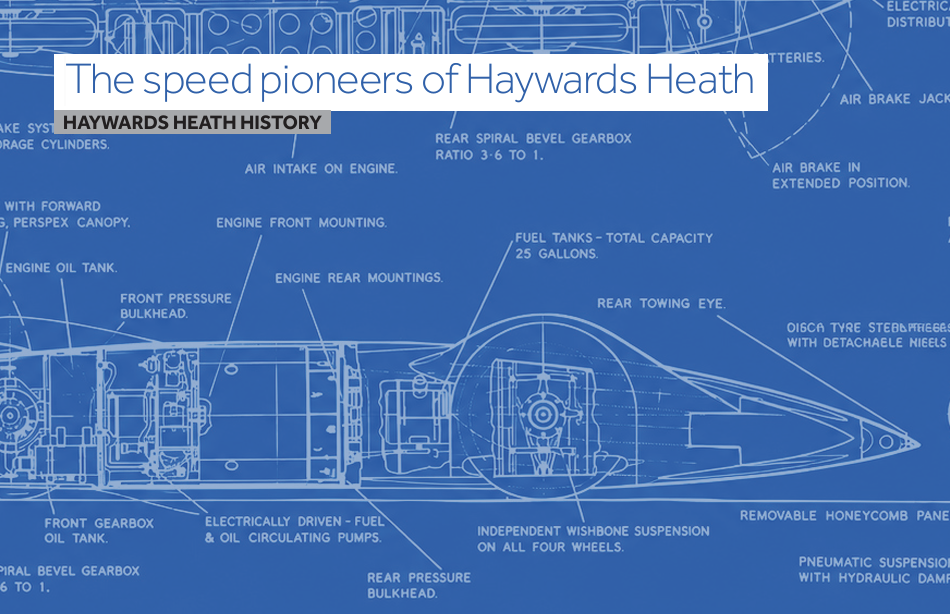
If you were to ask people in Haywards Heath about Bluebird, they might know the name Donald Campbell, the world speed records he set and the accident that took his life on Coniston Water in 1967. However, they might not know that many of the Bluebird cars and hydroplanes were built here in Haywards Heath. It was not something either David or I knew about either until a local resident mentioned, almost in passing, that the firm behind it, Norris Brothers, once had a factory here in town.
Norris Brothers Research and Development Ltd was founded in Burgess Hill in 1946 by three of five Norris brothers, working as shareholders: Ken, the eldest and an aerodynamicist; Lou, who ran the Worcester Valve Company alongside it; and Eric, an accountant who kept the books as company secretary. They hired specialist engineers and draughtsmen to solve problems other companies couldn’t manage alone. Bluebird, in both its forms, was only ever one project among many: military vehicles, nuclear instrumentation, telescopes, wind tunnels and aircraft engines. I spoke to two men who worked there in the 1960s, and who both still remember the innovative range of engineering achievements.
I met Michael Short in his home, where he showed me decades of memorabilia; newspaper supplements, photographs, and a school newsletter he still receives from those years. Tim Ravenhill came to our office, bringing with him his own memories, both written and recollected. Between them, they tell two very different stories about the same extraordinary place.
Michael Short joined Norris Brothers in the early 1960s, not long after Donald Campbell had crashed the original Bluebird car on the salt flats in Utah at an estimated speed of over 300mph. His first job, straight through the door, was to redesign the braking system. He stayed three and a half years, working on everything from the car itself to nuclear research at Harwell and Culham Labs, and the experience stayed with him. “I thank Norris’s for the rest of my working life for all the things I did,” he says. But it’s two moments from the car’s story he tells with the most enthusiasm.
The first happened at Lake Eyre, the dry salt flat in South Australia where Campbell ran the car in 1964. After weeks of runs, Leo Villa, Campbell’s long-serving mechanic, called a halt to check the car over. As Michael remembers it, Leo Villa told the team that the car had somehow grown to be half an inch wider than when they’d started. Nobody else had noticed it. The cause for this widening turned out to be the wishbones, which had been recently redesigned with ball-end bearings screwed onto tubular fittings, locked in place and wirelocked for safety. “In reality, you can lock them together,” Michael says, “but that still doesn’t stop them from moving in unison.” Under the strain of the runs, the fittings had been slowly working themselves loose. The whole car had to go back to England to be put right.
The second happened when BP took over as sponsors. Their publicity team arrived wanting five of the newest video cameras to be mounted on the car. The cameras, one of the first of their kind, were relatively small but still a significant weight to carry. As the chief engineer, Hugh Standing, was away on holiday, his junior draughtsmen agreed, bolting one camera halfway up the tail fin and another down inside the air intake. The chief engineer returned and was shown the drawings. As Michael recalls it, the engineer was blunt: the one on the fin would look pretty while it lasted, assuming it didn’t disturb the airflow and tear the fin off altogether, and the one in the air intake had to come out entirely. With air rushing into the engine far faster than it moved over the car, the camera would be ripped loose and destroy the engine behind it. Only the suspension-mounted camera survived his review.
Tim Ravenhill joined Norris Brothers in 1965 as a design draughtsman, arriving just as Donald Campbell was pushing to get the Bluebird hydroplane up to 300 miles an hour. His main task was designing the installation for a new, more powerful engine to replace the old wartime one it had been running on, but before that work could begin, the parts to do it had to be tracked down from wherever they could be found.
One came from a scrapped Folland Gnat fighter jet, discovered in an aircraft scrapyard near Dunsfold. Tim went to look it over and spoke to the chief test pilot there about how easily it could be dismantled and transported. Taking the wings off by conventional means would have needed a lot of man-hours, so the scrapyard’s team found a quicker way: they cut the wings off with a gas torch and delivered what was left to Haywards Heath on the back of a lorry the following Friday afternoon. By Saturday morning, Tim was pulling the engine out to begin designing its installation into Bluebird. The jet donated more than just its engine. The hydroplane had poor directional stability, so the Gnat’s own fin was taken and fitted to the back of it to help provide that stability.
The second story is a smaller, more personal one. Before the newly engined hydroplane went up to Coniston Water for its record attempts, Tim’s first son was born in 1966. “We sat him in the cockpit as a little baby,” he says. It was a personal moment inside a hydroplane that would soon be making headlines, one Tim still remembers clearly, decades on.
Beyond Bluebird, the range of what the engineers at Norris Brothers turned their hands to is almost hard to credit. There was a telescope, built for the Royal Observatory at Herstmonceux; a wind tunnel, designed for Brighton University; one of the country’s first photocopiers, developed in-house; an early inertiareel seatbelt mechanism, the kind still fitted in every car today; a pneumatically controlled machine tool; and the installation of a gas turbine engine inside an armoured tracked vehicle for the Ministry of Defence; and a microswitch that became a global standard for everything from household appliances to large passenger aircraft. An engineering firm, it seems, that could turn its hand to almost anything.
Michael Short and Tim Ravenhill worked at Norris Brothers only a few years apart, on different parts of the same extraordinary machines, yet neither man’s memories overlap with the other’s. That, more than anything, says something about the sheer scale of what the firm took on, and indeed, accomplished: two witnesses, two entirely different sets of anecdotes, and still only a fraction of the whole picture. Walk around Haywards Heath today and there is more of a trace than you might expect, if you know where to look: in a small new estate off the Balcombe Road, you will find Norris Lane, Bluebird Grove, Coniston Avenue and Campbell Mead all added quietly to the town’s street names, each a small tribute to the town’s engineering history. The clearest marker of all, a blue plaque on the entrance pillar of the Flowserve office building, is, according to Tim, in the wrong place. The Worcester Valve Company, coowned by Lou Norris, needed a new building of its own, and it was built next door to Norris Brothers, the building now occupied by Flowserve. “So, the blue plaque should be on the building just before that,” he tells me. A small detail but an important one for those who remember the pioneering work undertaken by teams of engineers who, for a few decades, helped build some of the fastest machines in the world.