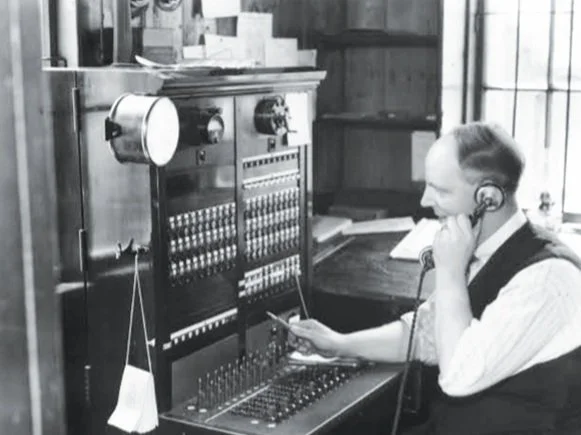
Abridged from Cuckfield to Haywards Heath, a tale of two exchanges.
By Steve Turner
The story at the end of part 1 finished at the point where the manual exchange in Boltro Road had reached maximum capacity and Haywards Heath had effectively run out of telephone numbers. Connections had reached 2,930 and 220 customers were waiting in the queue for a line.
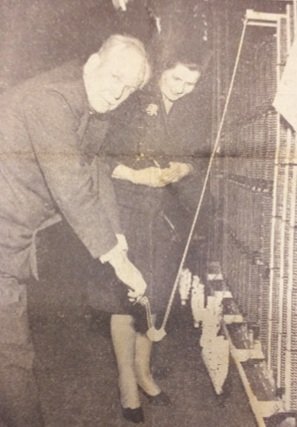
In 1960, plans were drawn up for a new automatic exchange. It couldn’t be too far from the manual exchange, transferring existing lines needed to be as straightforward as possible, but there was a further complication: the decision had been made to close the only other manual exchange in the area, at Cuckfield, and transfer those 600 lines to Haywards Heath.
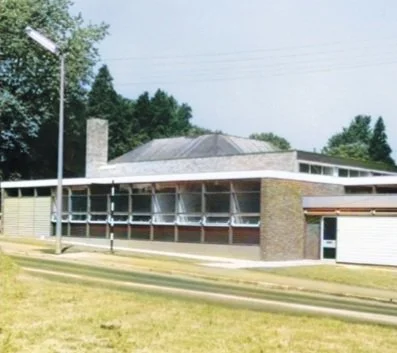
Luckily, a large empty plot was available on Paddockhall Road, directly opposite Boltro Road. Building began in 1962, with contractors Andrew Keith & Co. of Worthing appointed for the work. The single-storey building cost £36,800.
While construction was under way, cables were laid from the old building to the new, a distance of around 50 yards, and a new 1,200-pair cable was installed to connect the new exchange to Cuckfield. Automatic exchanges need dials rather than operators, so while builders and cable layers did their work, a team of engineers converted 3,472 telephones to dial operation, while also installing lines to the growing number of homes and businesses waiting for service.
Once the building was complete, equipping it fell to Ericsson Telephones Ltd. of Nottingham. Twenty engineers spent 15 months installing enough equipment for 4,800 lines; GPO engineers then spent a further 15 months testing and proving the system before the changeover. The equipment alone cost £243,800. The plan was for this capacity to last until 1969, a plan that would fail spectacularly in the face of surging demand.
The changeover finally happened at 1.30pm on Wednesday, 10th March 1965. Wednesday was a common choice for such events: half-day closing, introduced in 1911 to give shop workers a mid-week break, meant that any problems could be resolved before businesses reopened the next day. (The practice was repealed in 1994.)
It was a momentous occasion for the town. Subscribers, as customers were then known, could now dial their own calls, not only locally but long distance. Automation also transformed the wider Mid Sussex area. Previously, surrounding towns and villages, though automatic themselves, could only dial within their own exchange; any call to another town, village, or longdistance number had to be routed through the manual exchange at Haywards Heath. It is hard to conceive now quite what a difference this made.
With a total bill for building and equipping the exchange approaching £300,000, the occasion was marked with some ceremony. A reception was held at the Hayworthe Hotel, around the corner from the exchange, where acting area manager Mr Wellsted thanked all involved. He noted that the new exchange would handle the 20,000 daily calls previously managed by 28 operators and acknowledged that automation meant all calls would now be metered and therefore chargeable though he expected connection to be quicker and bills to be lower.
Another significant benefit was that the 999 service, in existence since 1937, was now available across the whole of Mid Sussex. Of the seven supervisors, 71 full-time and 25 part-time operators displaced by the changeover, three took retirement and three moved to new jobs, while the remainder transferred to exchanges at Crawley, Brighton, Horsham, or East Grinstead, where 999 and 100 calls continued to be handled.
The switch to the new equipment also required changes to telephone numbers. The new system required a minimum of four or five digits: numbers from 0–999 were prefixed with 3, those from 1000–1999 took a 5, four-digit numbers beginning with 2 were unchanged, and Cuckfield numbers became Haywards Heath 4xxx.
As demand for numbers grew further, an upper floor was added to the exchange. Four-digit numbers were prefixed with 41 and five-digit numbers with a 4, producing the six-digit numbers in use today. The area code 01444 has its own logic: in the days of lettered dials, Haywards Heath would have been allocated 0HH4, which in time became 0444. With the march of fibre connections, mobile phones and broadband-only services, the use of traditional telephone numbers is in decline. What comes next remains to be seen.