
By Jonathan Taylor
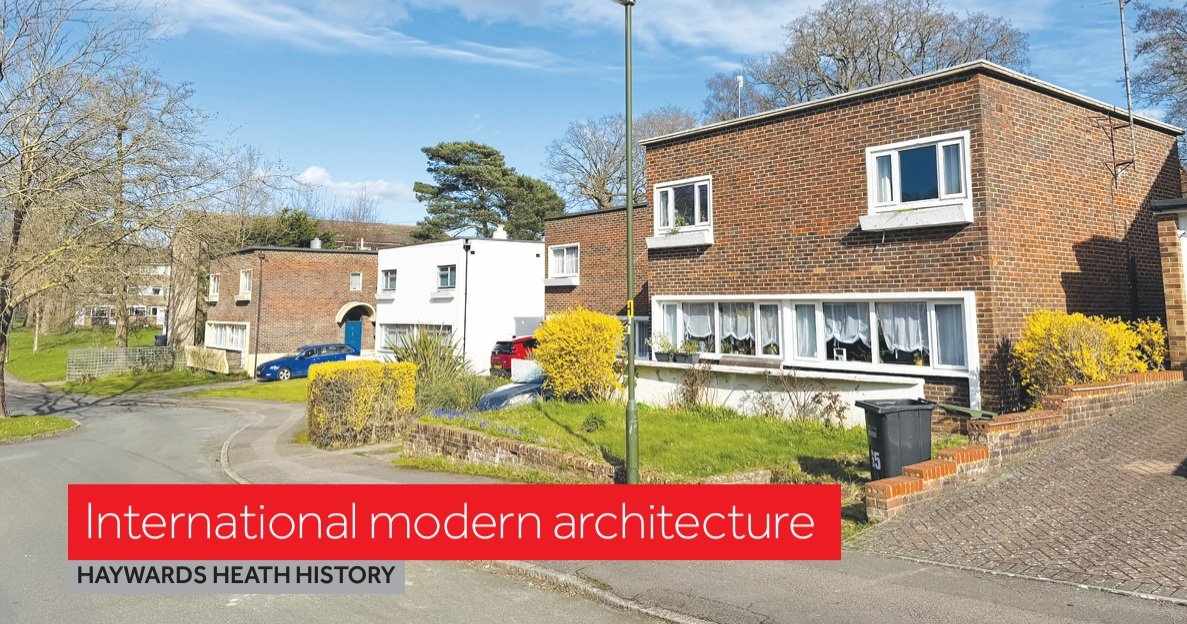
Haywards Heath is not noted for cutting edge architecture but hidden away on its southern outskirts is an unusual early example of the ‘International Modern’ style: eight houses designed by Berthold Lubetkin and the Tecton architectural practice, completed in 1936.
Born in Georgia, Lubetkin (1901 to 1990) was one of the most important figures of the Modern Movement in Britain. He studied and worked in Paris before moving to London in 1931, and in 1932 he co-founded the Tecton group with six architectural association graduates, including Anthony Chitty.
The houses in Sunnywood Drive, were an unusual venture into speculative housing design for Lubetkin and Tecton. The client, a developer, challenged them to create modern houses that were marketable to ordinary people.
Initially, Cuckfield Urban District Council refused permission for the houses. Tecton appealed, and as a result, a Ministry of Health inquiry was held on 4th December 1934, in Haywards Heath. (The Ministry of Health had taken over the powers of the Local Government Board in 1919, including deciding on planning appeals, presumably planning was initially seen as a matter of health and sanitation.)
The Council’s case was that ‘design such as the appellants proposed would be too big a jump from the present style of houses in the immediate neighbourhood’. The Council did not call any expert witnesses to the inquiry, but ‘relied upon their knowledge of the district’.
The Council had in fact received a report on the development from its advisory ‘Panel of Architects’. Mr. Goulburn Lovell, President of the Southeastern Society of Architects, attended the inquiry uninvited, and protested ‘If they [the Council] were relying upon the PaneI of Architects, why were we not instructed, and asked to come here to give our views? I take great exception to this’. As the Panel was of the opinion that the proposed houses were ‘a group of quite scholarly design’ and had merely recommended the texture of the brickwork should be improved, it seems likely that the Council did not call Mr Lovell as an expert witness, simply because it would undermine their case for refusing planning permission.
Tecton was represented by Anthony Chitty, one of their founders, who argued that the Council were ‘not really interested in the merits of their designs, and either from lack of information, ill-will, or through unknown obscure interest, they were pursuing a purely negative and obstructive policy’. He condemned the ‘the mockTudor, half-timbered sham with which the countryside was being desecrated to-day’ and claimed ‘the underlying motives of [Tecton’s] designs were similar to those which characterized the Regency style. Modern materials had only been used to give a fuller and more complete expression to the original conception of the traditional builders’. (A full account of the inquiry can be found in the Mid Sussex Times for 11 December 1934.)
The ‘delightful position’ was in Great Haywoods Wood, owned by Mr. W. E. Stedman. When questioned at the inquiry, he said he ‘had sold a portion of the land for the purpose of that development. He saw no reason why the building of houses of that modern type should not prove a great success in that district’ and ‘it would not be worth my while to sell a small portion of my land for this development and spoil all the rest. I am spending upwards of £3,500 on this new road, and I can’t afford to jeopardize that outlay by furthering a scheme which would prove detrimental to my interests’.
The new road was intended to be called Birch Drive, but in May 1935 the district surveyor reported ‘that he had drawn the attention of the owner … to the unsuitability of the proposed name Birch Drive’. An alternative application from the owner then suggested the name Sunnywood Drive, which was accepted by the Council. It is not clear why Birch Drive was unsuitable, perhaps it was because Great Haywoods Wood was mixed woodland.
Click to enlarge
Despite Mr Chitty’s claim that the Tecton houses were simply a ‘more complete expression to the original conception of the traditional builders’, they were undoubtedly rather startling for the time. One correspondent to the Mid Sussex Times in 1936 wrote he had never ‘seen anything more incongruous than those buildings in such surroundings’ and ‘it is not pleasant to contemplate the erection of modern houses like square boxes stripped of everything that would give contrast or relief to bare walls’.
The eight Tecton houses still stand today. Seven of the eight are Grade II listed – one has been so altered that it can only be recognised by the characteristic arrangements of its windows, the flat roof having been replaced with a pitched roof. Perhaps regrettably, proposals to extend the estate to 60 or more similar houses came to nothing. The Mid Sussex Times’s correspondent quoted above, thought ‘that the majority of new houses, if not the highest form of art, are at least reasonable in appearance’, and, on that basis he would no doubt have approved of the later, conventional, houses built on Sunnywood Drive.